

With the subject "Interdisciplinary Professionalisation" (FÜP), the "Creative Career Center" offers students a wide range of courses that provide them with important key skills for their professional training and further education and thus prepare them for the challenges of the music profession. The following overview shows the seminars, courses and projects currently on offer. Registration for the individual courses takes place via the student portal eislerCampus.
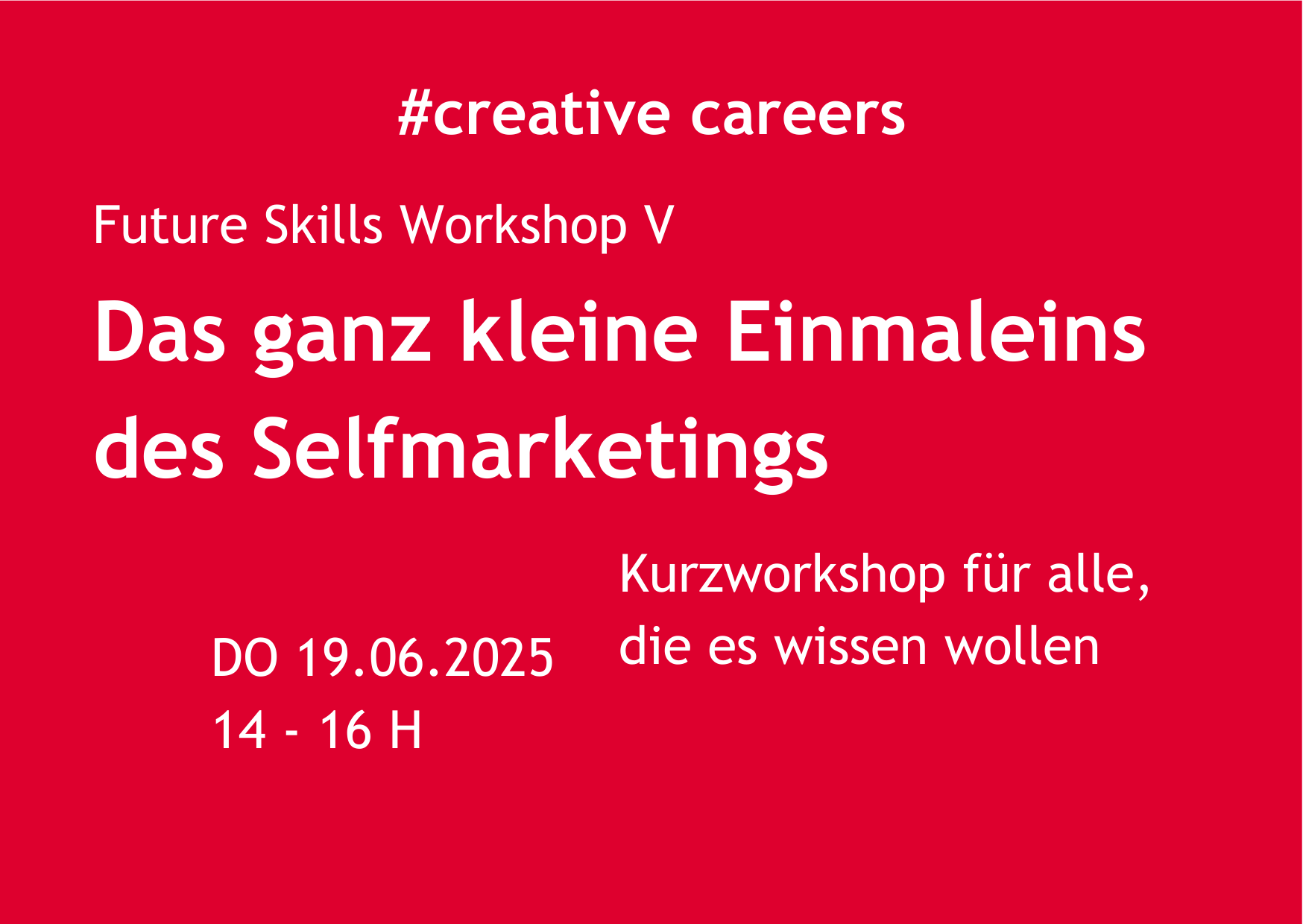
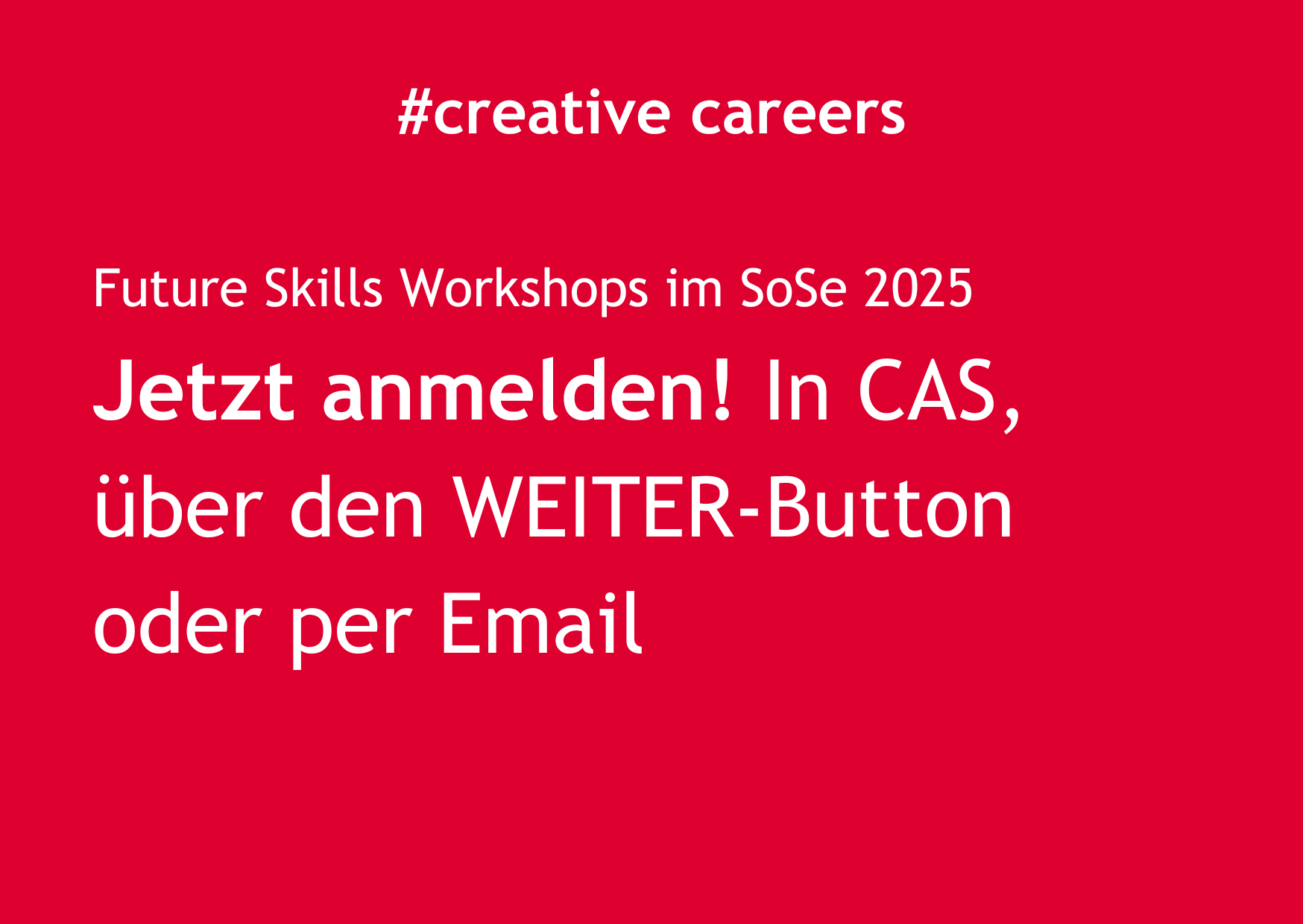
Future Skills Workshops in the Summer Semester 2025
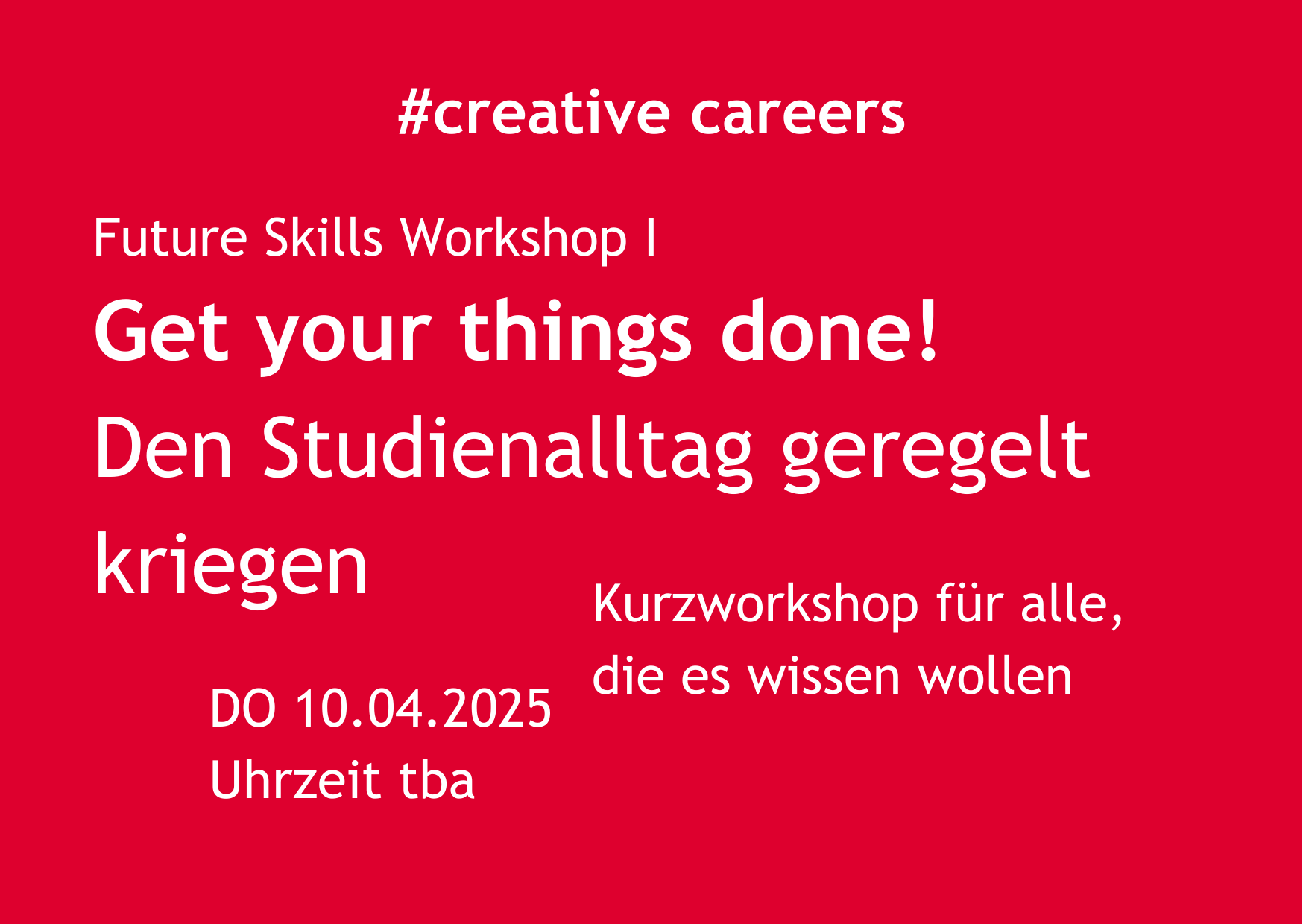
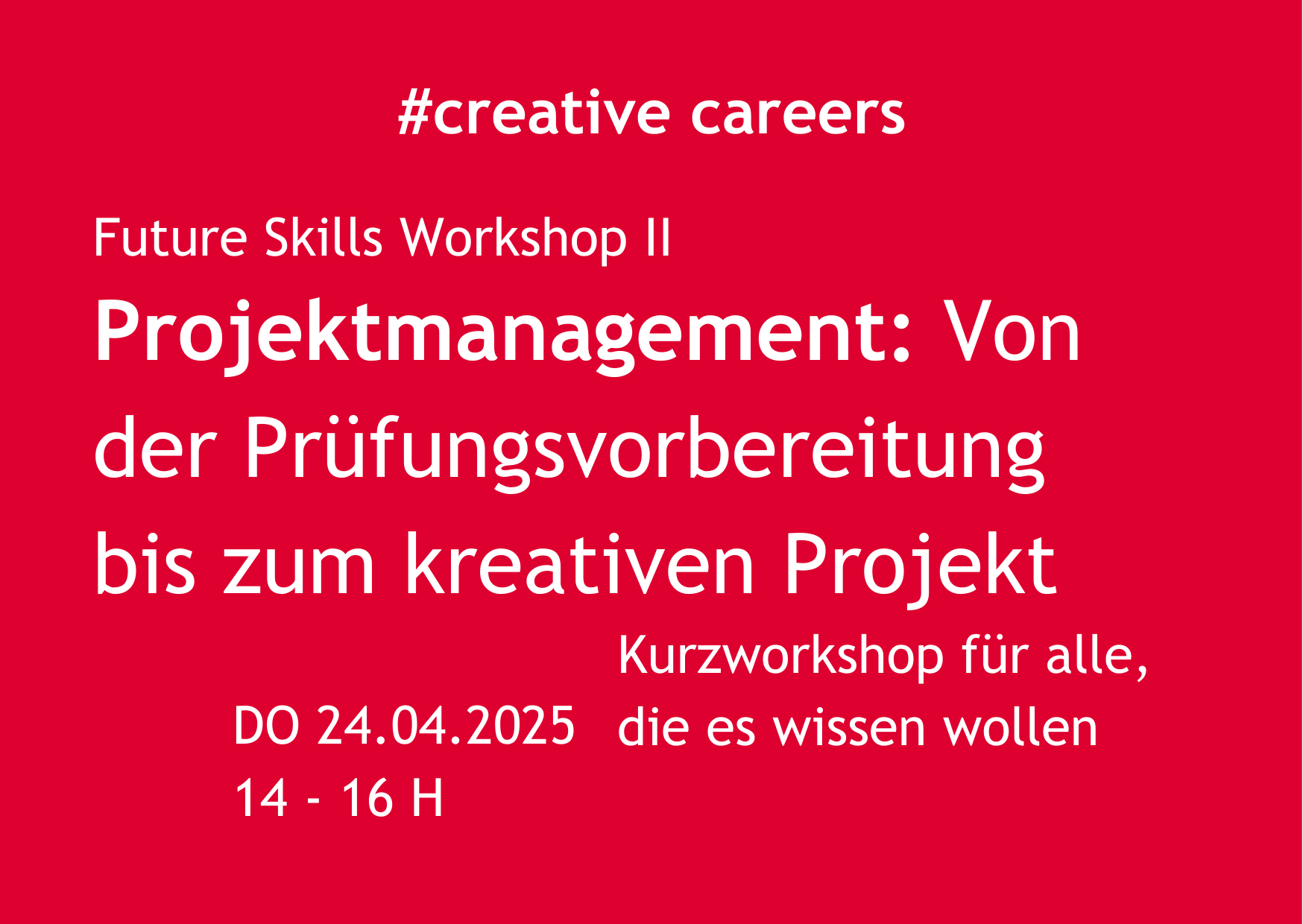
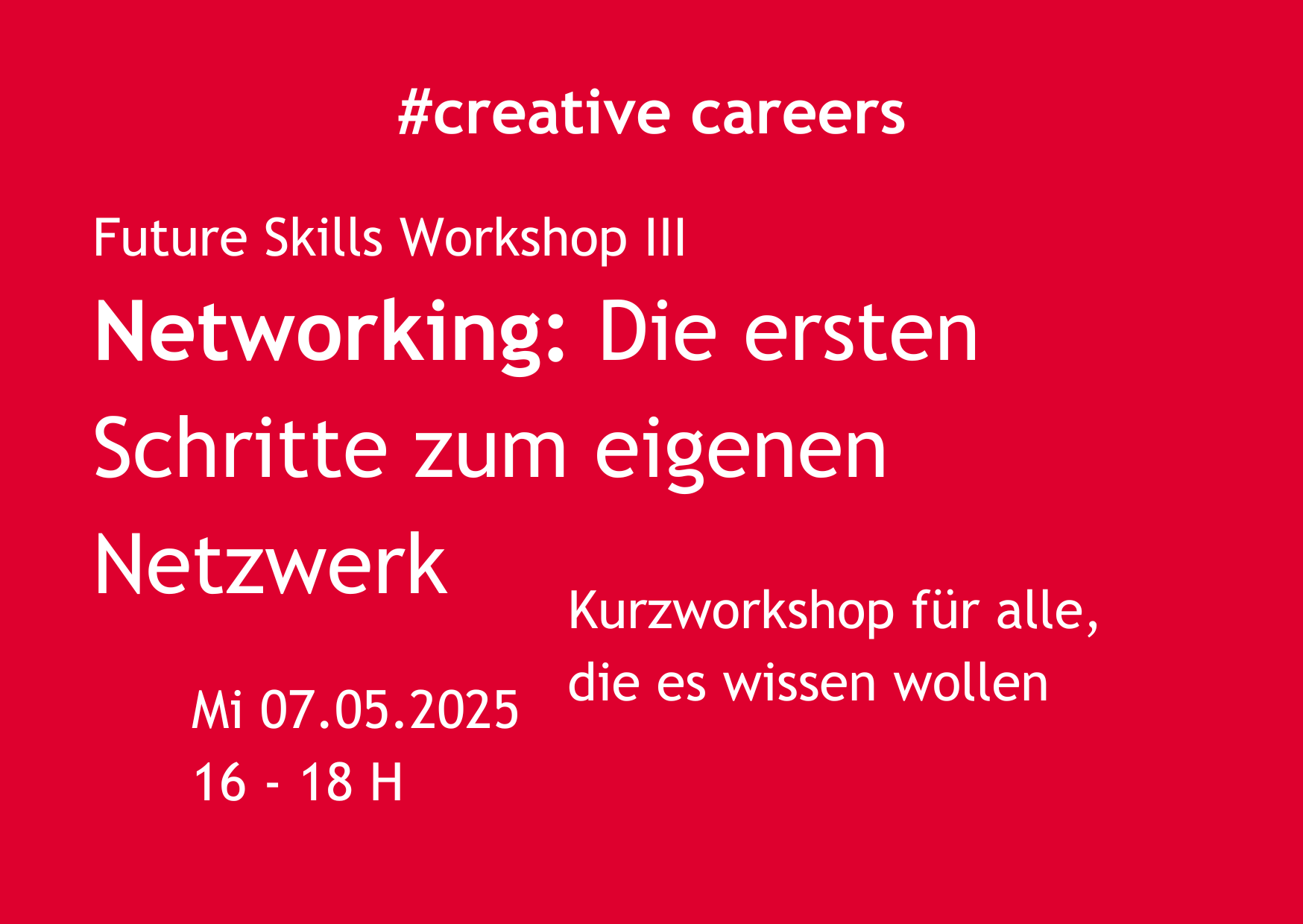
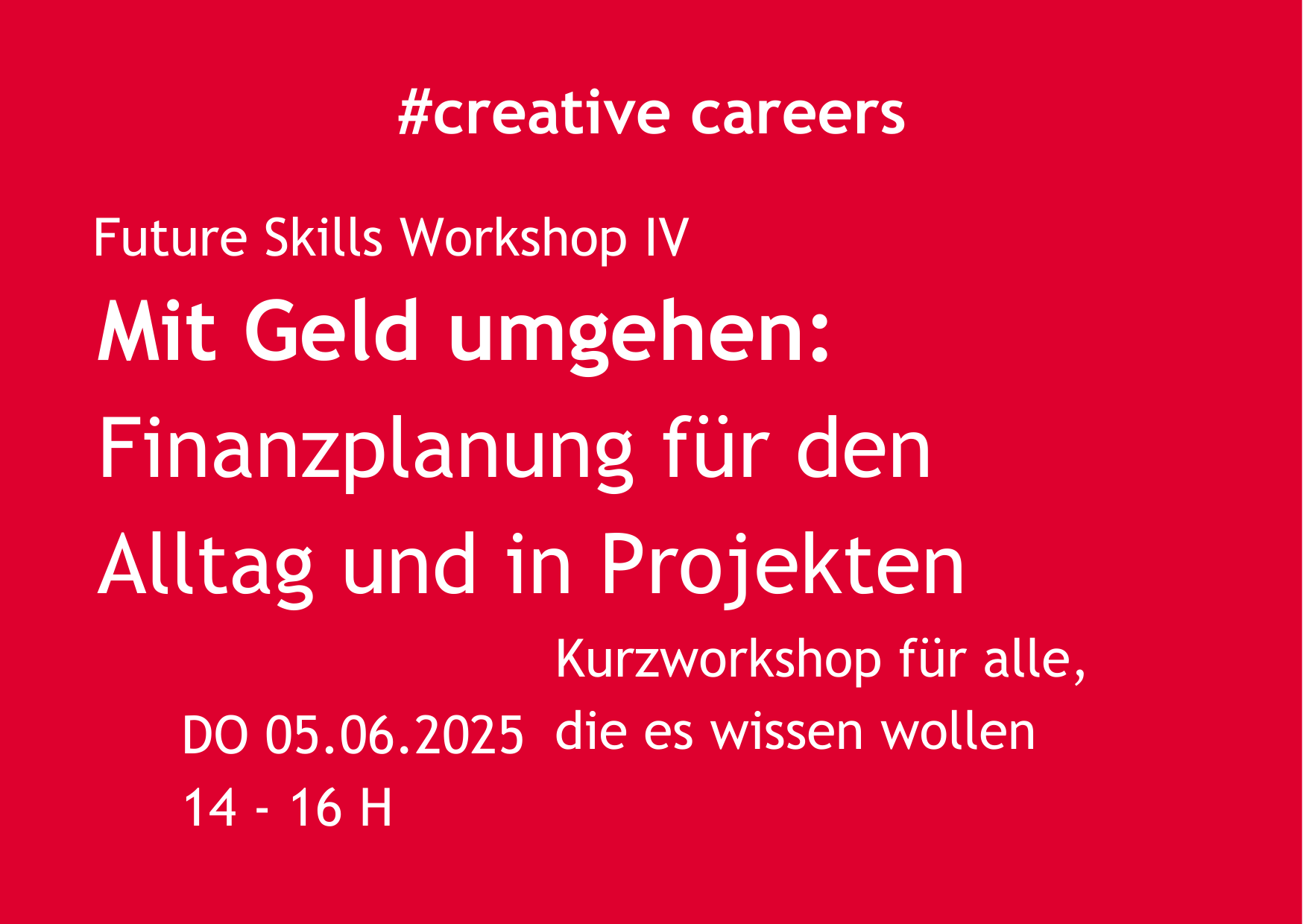
Short and crisp input, immediately applied to specific tasks and/or challenges. No ECTS points, but know-how for life! Registration via CAS, the "read more" button or by e-mail to Kirsten Peters.
Teaser list
Teaser list
Courses offered in the Summer Semester 2025
This link will take you to the overview of the Creative Career Centre courses (FÜP area) in the course catalogue. There you will also find detailed information on the respective courses, e.g. on the supervising lecturers, the semester dates and the ECTS credits.
You can register for all courses via the student portal eislerCampus (CAS). After the registration deadline, you can still register for the courses by sending an email to Kirsten Peters.
The following courses are offered in the current semester:
The professionalisation of musicans requires the development of key skills in addition to specialist skills. In addition to the ability to organise yourself in order to achieve your goals, you also need to be aware of the context of your professional activity and how to move and present yourself professionally within it.
In addition to very practical topics such as self-organisation, time management, communication and self-presentation, this basic seminar is primarily about exchanging ideas about personal development opportunities: e.g. dealing with your own weaknesses and strengths, setting priorities and personal goals. In addition, an initial overview of the cultural scene in Germany also provides space for discussion about current challenges and development trends in the music industry.
The professionalisation of musicans requires the development of key skills in addition to specialist skills. In addition to the ability to organise yourself in order to achieve your goals, you also need to be aware of the context of your professional activity and how to move and present yourself professionally within it.
Building on the self-management seminar, which focussed on very personal issues, this seminar aims to provide concrete ideas for implementation with regard to future career opportunities. Topics such as self-marketing, networking, creativity, concept development and project management are addressed and demonstrated in a practical way using model projects.
The classical concert business is in a tough cut-throat competition with colourful events and hip media. How do you attract, mould and retain an audience? Which tried and tested, which innovative recipes and ideas characterise an attractive programme design? What food for thought is there for your own music-making and traditional performance practice? How has the concert business developed over time? There are even more questions and perhaps also a few answers in this event, which also sees itself - if possible - as a platform for exchanging experiences, self-experiments and performative experiments. The aim is to develop orientation for one's own artistic decisions and attitudes in the current trends of contemporary performance practice.
Writing about music or even yourself: for some it's art, for others it's torture. Yet it is perfectly possible to learn how to write good texts. This writing workshop is about getting to know the tools of the trade and trying out various methods of (creative) writing in order to have fun with it and be equipped when it comes to formulating an appealing biography, an exciting concept or a creative programme booklet text.
In the digital world, there are many opportunities to present yourself as a musician and interact with your audience. Appealing and authentic digital activities on Instagram, YouTube and alternative formats as well as your own website are platforms for musicians to build up a targeted fan community, for example, to communicate and utilise their own projects such as (digital) concerts more widely or to acquire concert engagements. Specifically, various digital media formats will be discussed and reflected upon in the seminar. The aim is to initiate your own digital activities in a creative and collegial exchange.
As a trained pianist, lawyer and attorney Steven Reich has a special perspective on the legal system. In his guide "The artist and his rights", he compiles a compact cross-section of information from various areas of law that are required for artists and their contractual partners (e.g. agencies, theatres, media producers and other exploiters). In this seminar, he deliberately avoids academic ballast and concentrates on practical issues for musicians in a language that is also understandable for non-lawyers, such as: the freedom of art under the Basic Law, copyright, contract and tax law, collecting societies or the Artists' Social Security Act. Topics of interest can be addressed as required!
- The freedom of art and the right to intellectual property: copyright law
- Making money with music: the collecting societies GVL and GEMA
- Understanding contracts for a commissioned work or a concert: Everything you need to know about music contract law
- Labour law for musicians: occupational health and safety, fixed-term contracts, termination, self-employment, holidays
- Alone in the tax and insurance jungle? Everything you need to know about tax and the Artists' Social Security Act
- Going online and never getting out again: legal issues in the social media sector
Professional classical musicians have to spend a lot of time in isolated practice rooms. This makes it easy to overlook that they remain artists, who need extra-musical inspiration to continue to develop their artistry. In this course, you get a solid introduction to music philosophy in an understandable language. We will focus on the practical implications of the ideas of great thinkers for your own performance practice. The aim is to make room for critical questions, doubt and wonder and strengthen your ability to reflect on your own musicianship in a brave and open-minded way: important qualities in the swiftly changing cultural field.
Which audience do I want to make music for? Who actually sits in my concerts? What do they want and should know? And how do I create closeness with and to my music? Topics such as participation, cultural participation, integration and inclusion, audience development and community engagement, cultural education and digitality will be covered in the seminar. Various aspects will be dealt with in practical exercises and different ways of making connections will be tested.
For musicians, working with colleagues and cooperation partners in an international context is part of everyday life. Successful intercultural communication is a prerequisite, but can always be a challenge. Intercultural misunderstandings can lead to conflicts in a quartet or orchestra, for example, which can jeopardise successful collaboration. The aim of the seminar is to deepen understanding of one's own and other cultures and to develop solutions for culturally related problems.
The programme is primarily aimed at students who wish to acquire knowledge in the field of team development for professional activities in internationally active orchestras. After completing the course, students will be able to reflect on their own values and behavioural patterns and counteract standardisation and stereotyping. They will be able to independently develop ideas for change.
The aim of this seminar is to bring your own artistic ideas, dreams and visions closer to realisation. This can be the development of self-employment, festivals or the founding of an ensemble - there are no limits to the imagination! With the help of basic project management knowledge, the course systematically focuses on the realisation of this content. The decisive factor here is the will and passion to achieve your goals, because "Only those who burn themselves can ignite others", said the Hamburg musician and cultural manager Herrmann Rauhe. We would like to follow this quote and feel our entrepreneurial and founding spirit.
Resilience refers to a psychological resistance that enables people to successfully cope with stress, setbacks and difficult situations without suffering long-term negative effects. It is the ability to recover from failure, learn from criticism and continue despite obstacles.
Strengthening one's own resilience is particularly important for music students, as it helps them to deal with the challenges and stresses of their studies and future career. In the block seminar, the various facets of resilience are examined in detail and trained with a focus on existing resources.
Having to speak in front of an audience or camera is a real challenge for many musicians. However, more and more concert and competition organisers are demanding exactly that. What is important here? How does a language sound that people like to listen to? How do I structure an interview? How should I answer questions myself? A practical course in which you can practise presenting in a safe space. If required, we can also develop moderations for specific upcoming concert projects!
Talking about music as part of the artistic personality and mediation will play a greater role in the future than it has in the past. This is now a profession in its own right. New concert formats require moderators to build bridges, and a growing audience - in all age groups - wants to be won over through vivid introductions to music. The aim is to create a new closeness and to be able to listen to the music with different ears after the presentation.
Presenting - the authentic mixture of art and technique - can be practised like an instrument. Charisma, humour and a talent for speaking are an advantage here, but first and foremost this course should reduce possible fears and whet the appetite for an exciting (playing) field.
What matters? What is at stake, what is relevant, what is possible in our artistic practice and collaboration? What communication and feedback culture can and do we want to establish and practise? Which methods and approaches can support which creative processes and when?
The practical seminar deals with individual and collective working methods in artistic processes and projects. In particular, the aspects of 'communication' and 'leadership' in team and project work are the subject of this seminar. Feedback is a core element in communication and an essential component of creative and working processes as well as in leadership tasks in our everyday artistic and musical lives and work. The variety of procedures and approaches is interesting. In block modules and project appointments, awareness is created and concrete feedback methodology and tools for practice are taught, through which we can communicate well, have a high quality and motivating effect in our specific roles and situations and work and create together. The focus is on the respective areas of expertise and questions of the seminar participants, your respective roles and practical projects. We will develop our own feedback formats and working methods. The invitation of professionally interesting artists from the Berlin scene to the seminar will be integrated and jointly organised where possible.
What is my role as an artist today? How can I as an artist use my music to provide social impetus? Do we musicians have a social responsibility? Artistic citizenship describes an attitude in which there should be no boundary between artistic-professional excellence, social awareness and social responsibility; rather, musicians are required to have an inner attitude that is not only explained by the music itself, but also opens up a social perspective. Artistic action has the great potential to release positive things, to bring people together - e.g. with music - and to connect them in joint artistic action.
In this seminar, students will be strengthened in their role as musicians and in the attitude of artistic citizenship, which will enable them to open up their own visions and new spaces for music in society and to pursue this path professionally and consciously.